Update
Embedl and Space Cargo Unlimited Bring AI Autonomy to the Space Edge
Embedl and Space Cargo Unlimited demonstrate autonomous onboard AI for protein crystallization experiments in microgravity using NVIDIA Jetson.
The prototype monitors experiments, identifies anomalies and recommends actions between ground contacts, supporting more autonomous research and manufacturing in orbit. It will be presented at NVIDIA GTC Berlin on 21 and 22 October.
Luxembourg, 15 October 2026, Embedl and Space Cargo Unlimited today announced an onboard AI prototype that autonomously monitors protein crystallization experiments using a single NVIDIA Jetson Orin NX 16GB module. Developed for future BentoBox missions, the system analyzes experiment imagery, flags anomalies and recommends actions without requiring continuous ground connectivity. Space Cargo Unlimited designed the pipeline and trained the classifier, while Embedl built the optimized version of NVIDIA Cosmos 3 Edge that runs on the module. The prototype will be on show at booth 7067 on 21 and 22 October.
Microgravity allows experiments that cannot be run on Earth, and drug research has used it for decades. Protein crystals grown in orbit can be larger and of higher resolution than those grown on the ground. Drug companies and academic researchers have therefore flown hundreds of protein crystallization experiments on the International Space Station. In NASA’s real-time crystal growth experiments, the images are downlinked for scientists on the ground to evaluate. Space Cargo Unlimited’s BentoBox will fly on uncrewed capsules, with ground contact only in short passes and nobody on board to act in between. The prototype moves that judgment on board.

Figure 1. Human insulin crystals grown in 1-g (left) and in microgravity (right). Image: NASA.
The pipeline runs two models on the module. Each experiment is a plate of wells, and each well holds a droplet in which a crystal may form. A ResNet-50 classifier scores every well image in milliseconds. Space Cargo Unlimited trained the classifier on images from MARCO, a public dataset of 462,804 labeled crystallization images. The classifier runs on the module’s Deep Learning Accelerator through NVIDIA TensorRT, so the GPU stays free for the reasoning model. When the classifier cannot explain an image, is unsure, or sees a well diverge from the expected sequence, it hands over to NVIDIA Cosmos 3 Edge on the GPU. The model explains the likely cause and recommends an action. In flight, only the verdict and the flagged frames need to be downlinked.

Figure 2. The two-model pipeline on one NVIDIA Jetson Orin NX 16GB module: the classifier scores every image on the Deep Learning Accelerator, NVIDIA Cosmos 3 Edge runs on the GPU only for the images the rules escalate, and only the verdict and the flagged frames are downlinked.
Cosmos 3 Edge is NVIDIA’s 4-billion-parameter open model for reasoning, robot actions and video generation on edge computers, released in July 2026. The demonstration uses its reasoner, which Embedl optimized for NVIDIA TensorRT Edge-LLM. On NVIDIA Jetson AGX Thor, Embedl's build decodes 208 tokens per second, three times the 68 tokens per second prior to optimization. The build also runs on smaller Jetson modules than the one in the prototype. On an 8GB memory ofNVIDIA Jetson Orin Nano Super, it decodes 152 tokens per second, the first published rate for the model on that board.
The same build's average score across five vision-language benchmarks is within 0.4 points of the unquantized model. Embedl’s builds are not limited to the reasoner: the model's action generator and video generator also run on the same 8GB memory.
“NVIDIA released Cosmos 3 Edge as an open model, and at four billion parameters it fits a Jetson module in a payload,” said Hans Salomonsson, CEO and co-founder of Embedl. “We made it run there fast enough that the payload gets an answer without waiting for the ground.”
“Bringing AI autonomy to space represents a paradigm shift for microgravity research and manufacturing,” said Nicolas Gaume, Co-Founder and CEO of Space Cargo Unlimited. “By enabling payloads to process what they see, identify anomalies and support decisions without relying on continuous ground contact, we can offer customers more intelligent, responsive and adaptable experiments in orbit. This is an important step towards scaling autonomous in-space manufacturing across the future fleet of space factories we are building.”
Embedl’s build of NVIDIA Cosmos 3 Edge is now available on the Embedl Platform at embedl.com.
Enter a Hugging Face model ID and select a NVIDIA Jetson to run the model through your browser on a real Jetson in Embedl’s device farm, or on your own hardware with a single command. Over 1,000
optimized models are ready, with on-device performance and accuracy published side by side.
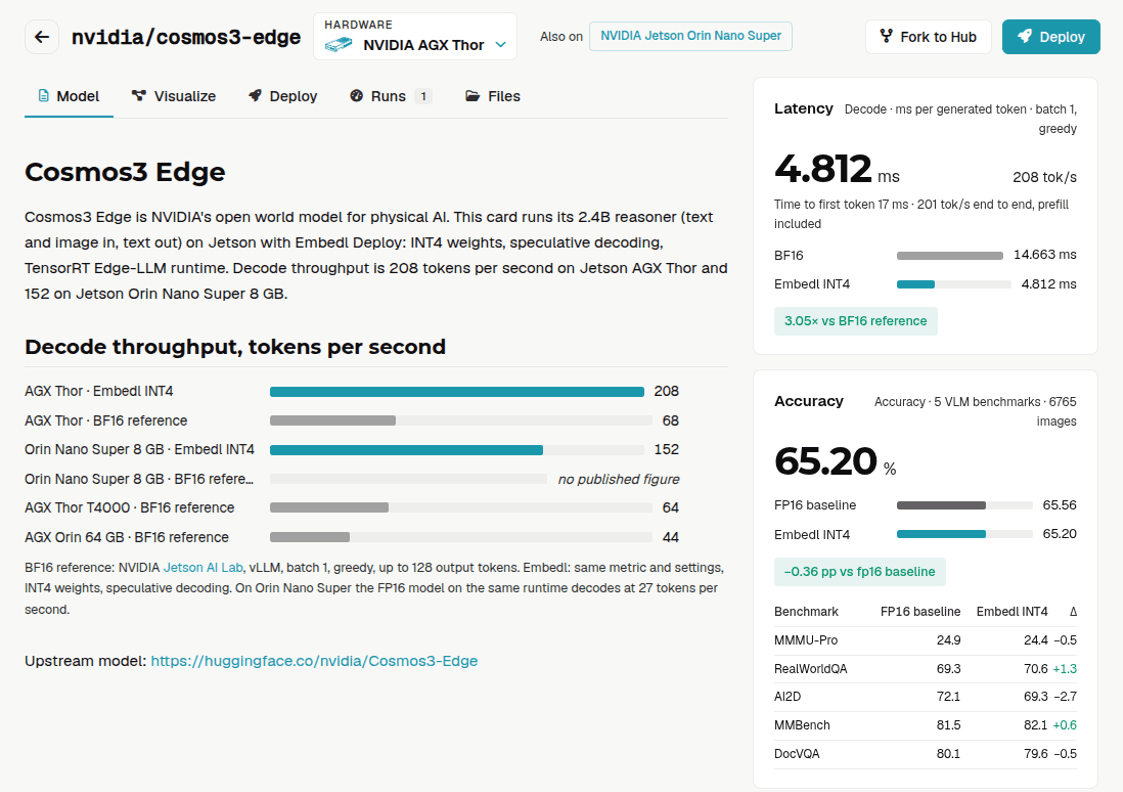
Figure 3. NVIDIA Cosmos 3 Edge on Jetson AGX Thor: throughput and accuracy across five vision-language benchmarks.

About Embedl
Embedl builds the infrastructure that takes physical AI from PyTorch to production. Its platform gives developers optimized models that run on real edge devices, with on-device benchmarks. Embedl Hub brings the same workflow on premises, with experiment tracking and the traceability that regulated industries require. Founded in 2018 in Gothenburg, Sweden, with an office in Palo Alto, the company works with automotive, space, robotics and defense companies, and is a member of the NVIDIA Inception program.

About Space Cargo Unlimited
Space Cargo Unlimited enables industries to manufacture in space at scale to improve life on Earth. Headquartered in Luxembourg, it develops BentoBox, a standardized autonomous platform for microgravity research and manufacturing, and REV1, its next-generation reusable orbital vehicle designed to provide dedicated, high-capacity access to and return from space. Together, BentoBox and REV1 form the foundation of a scalable, fleet-based infrastructure for end-to-end commercial manufacturing in low Earth orbit.
Media contacts
Embedl: Wilhelm Tranheden, wilhelm@embedl.com
Space Cargo Unlimited: Éanna Doyle, edoyle@space-cu.com